
Top of page Skip navigation
Consultancy
Better Communication CIC is able to support commissioners, providers and practitioners with implementing change to deliver better outcomes for children and young people.


MOdelling Therapies for Improved Futures

Welcome to the MOTIF study home page.

Our research begins on 1st March, 2026 and will conclude by 28th February, 2028.

We will be sharing more detail about our research as it progresses so please check this page regularly.

We will also be sharing opportunities to participate through this web page.


Workshops

We will be running workshops for children & young people and their families as part of the MOTIF project. 

Please use the buttons below to navigate to the 'pre-workshop' page for children & young people, or the page for families.


Children & Young People Workshops                                                               Parent/Family Workshops


About MOTIF

Here is our opening message about the study and also a brief summary that explains what we will be doing.  More detailed descriptions of each part of the reasearch will be added as we go.

 
We are excited to announce that a two-year, multiprofessional research collaboration, funded by the National Institute for Health
and Care Research through the Policy Research Programme on behalf of the Department of Health and Social Care, will begin on
1st March, 2026.
 
Marie Gascoigne, Better Communication CIC, is the Chief Investigator together with Professor Vicky Joffe, University of Essex, as
Co-Principal Investigator. The MOdelling Therapies for Improved Futures (MOTIF) study will take a population-based approach to
identifying needs, understanding how provision from therapists is commissioned and delivered, and developing workforce models
including a range of variables building on the Balanced System methodology.
 
The research team draws upon expertise across speech and language therapy, occupational therapy and physiotherapy as well
experience of workforce modelling and commissioning across health and education sectors. Our team includes Dr Hortensia
Gimeno, Clinical Academic Occupational Therapist, NIHR Advanced Fellow, and Reader in Child Health Research, QMUL who
leads a mixed methods work package to inform the workforce model, Professor Reinhold Scherer, Professor of Brain-Computer
Interfaces and Neural Engineering, University of Essex, who will contribute expertise in quantitative modelling and computer-
based simulations, Dr Emma Pagnamenta, University of Reading, clinical academic speech and language therapist leading on our
Young Person and Parent engagement and public involvement alongside Sophia Hill, a young person with lived experience of
SEND as co-researcher. In addition, Sharon Tuppeny, Children's Occupational Therapist and Maxine Darby, Children's
Physiotherapist join our team bringing extensive experience of service redesign as part of the Better Communication CIC team.
 
We shall be sharing more information about this important research as the project progresses. Pease visit our MOTIF website for
 
Here is a summary of what this research is going to do.
 
Meeting the needs of children and young people (0-18) with Special Educational Needs and/or Disabilities:
modelling the Allied Health Professional therapy workforce within integrated children's services
 
The MOdelling Therapies for Improved Futures (MOTIF) study aims to provide workforce modelling that estimates
the workforce needed to meet the needs of a population of CYP including those with SEND using the Balanced System
 
What is the problem?
There are many children and young people who need support to learn at school and to achieve their potential.
Speech and language therapists, occupational therapists and physiotherapists are part of the team that can help.
The way support happens now isn't working for many children and young people who have special educational needs and disabilities.
The way we deliver therapy must change.
 
Why is this topic important?
The government wants to understand how many therapists are needed to provide the right support and therapy for children and young people.
We want to understand if we need more therapists in some areas of the country.
 
What is the research aim?
Our aim is to help plan therapy that supports children and young people with special educational needs and disabilities.
We want to make sure they get support that will make a difference.
This will help us decide what support should be paid for and given.
 
What is the research plan?
1. Look at reports from the government and other organisations that pay for special educational needs services and published research.
This will help us to understand who needs what type of support and if services are helping children and young people in the ways they need.

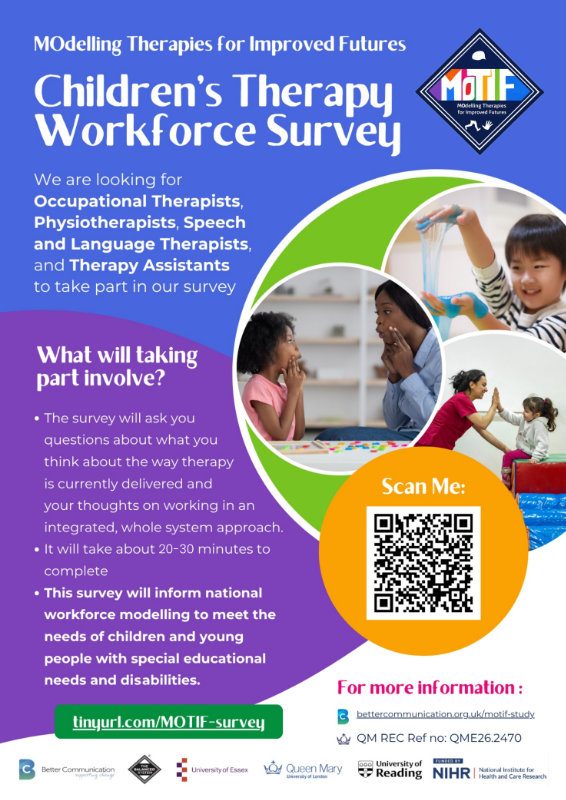
2. Send surveys to health professionals asking them what they think currently works well and what things aren't happening right
now that should be happening. We will also talk to people who decide how much money should be spent on what services.

3. Talk to children and young people as well as their families to learn what works for them. We will ask them what they think of
working in different ways - for example, working in a group with other children, or getting help in the class at school, or changing
things that will help a lot of children such as training school staff.


Who will do the research?
The research is being led by Better Communication CIC with the Universities of Essex, Reading and QMUL.
 
Our team includes health professionals and researchers who are experts in occupational therapy, physiotherapy and
speech and language therapy for children and young people with special educational needs and disabilities.
 
How will children and parents be involved?
A young person with lived experience of special educational needs and therapies is on our team and has helped to
develop this application. We will have a group of parents and children and young people who will help us to design and
deliver the project from start to finish.
 
How will we share the results?
We will work with children and young people and parents to create easy-to-understand ways to share the findings, like a
video or podcast. We will also share results through scientific papers, charities, or other channels, for example,
parent/carer forums.