
The Balanced System Explained
Written by Marie Gascoigne
This is my first attempt at writing a blog and it will no doubt be obvious! However, please stay with me as I have some really key information to share, especially at this time of high expectation and anticipation of the forthcoming SEND reforms.
With the help of some fantastic illustrations that have been created for us by Virpi Oinonen @virpi.businessillustrator.com, I am going to share the Balanced System Outcomes Framework and Core Delivery Principles.
The Balanced System started as my attempt at problem solving why ‘the system’ was not helping children and young people and their families get a sensible, functional, joined up approach to the support they needed at a particular moment in time for them. The Balanced System is not new! Some of the core concepts were embedded in a long-forgotten position paper I wrote for the Royal College of Speech and Language Therapists back in 2006! The Balanced System Five Strands, the Outcomes Framework, the Core Delivery Principles, then followed in 2008.
The good news – there are areas in the UK that have adopted the Balanced System as their means of planning and delivering services with great success – but systems change is hard work and there are plenty more areas where the whole system hasn’t got behind the philosophy and ways of working. It can’t be a ‘pick and mix’ approach– everyone has to be on the same bus going to the same destination!
So what? Well as I sit here in 2026, we are on the verge of a major change in those problematic SEND systems so, ever the optimist, what follows is intended to bring to life both the problem and the solution through the lens of the Balanced System.
THE PROBLEM
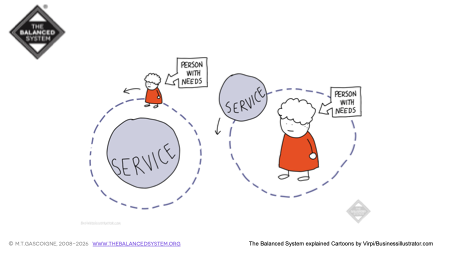
The current systems simply do not have the child or young person at the centre of the provision universe!
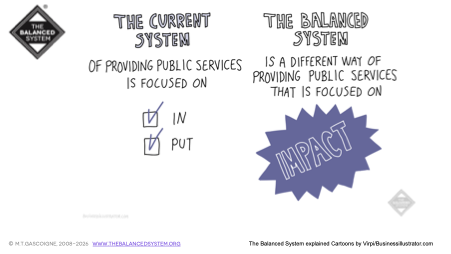
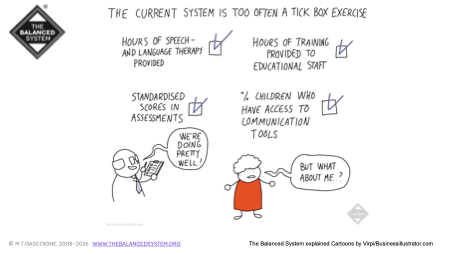
The current systems are over focused on INPUTs without paying enough attention to measuring IMPACT.
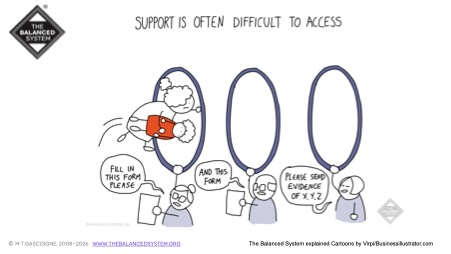
The current systems are not EASY TO ACCESS – placing the burden on families to understand and navigate the different parts of the system they need.
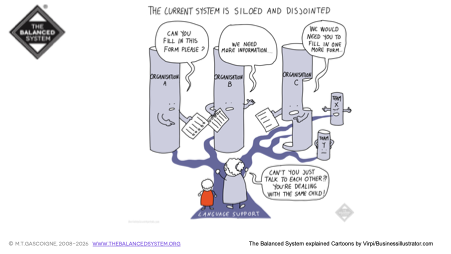
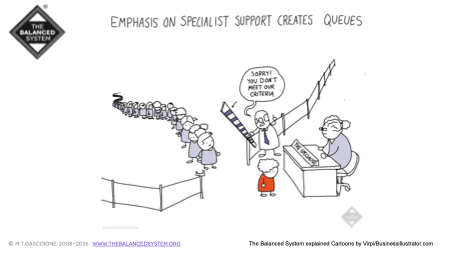
The current system creates unnecessary queues and then spends precious resources on counting and managing the queues, instead of solving the fundamental problems!
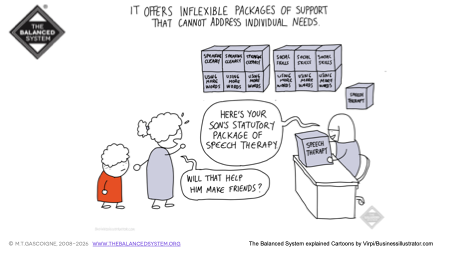
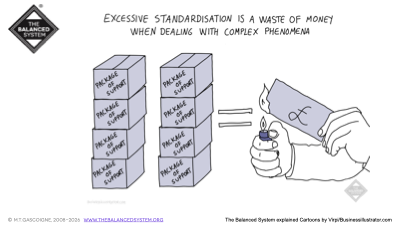
And when you get to the front – it is often an input package that is offered rather than starting with the functional outcomes that have brought the child, young person and family for help.
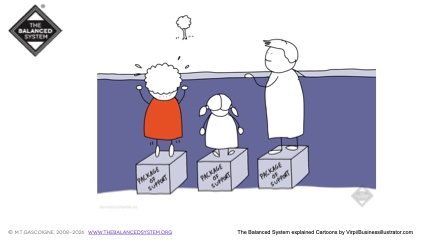
So what can we do about it?
The Balanced System starts with identifying the SYSTEM outcomes that all parts of the local area system have a contribution to achieving if children and young people are to have the best and most impactful support.
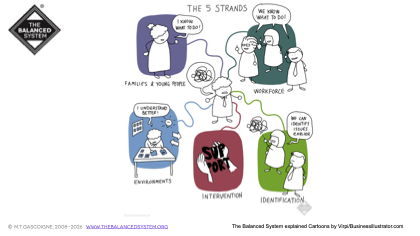
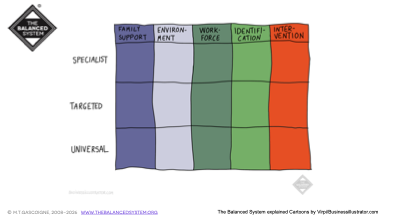
The Outcome Framework is based on Five Strands – key areas that need to be thought about and developed equally if we are to make a difference for the individuals who experience the system.
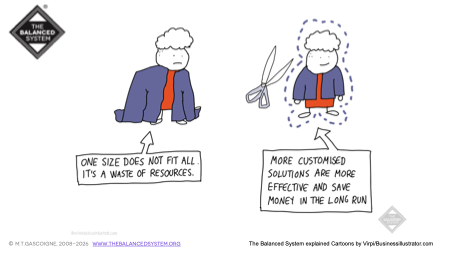
Intervention is only part of the solution and even then it can’t be a ‘one size fits all’.
We start with family support, we make sure the environments and places children live, learn and have leisure are supportive, we develop our whole workforce appropriately – that doesn’t mean the same for everyone, it means having people with a range of skills and abilities and the confidence and opportunity to use them in their everyday work, we identify needs early and provide immediate support or intervention even if more assessment and more individualised intervention is necessary as well.
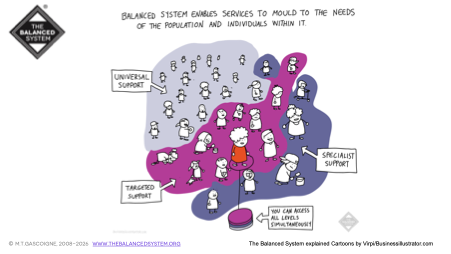
The Balanced System involves planning for a whole population – rather than specific diagnoses or sub-groups – because we need to be anticipating needs that have not yet been identified but we know from data are certain to be in every population and we need to plan for children and young people who need many parts of the system to get impactful support.
So we build a system that is based on shared outcomes for a population as the core building block, with a workforce that expects to work across boundaries and families that are central to the planning and can have confidence in the system they are part of developing in their local area.
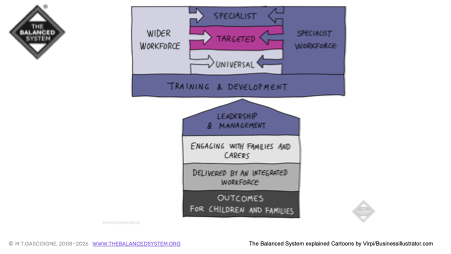
The outcomes for an area are a shared responsibility because the population is the same children and young people whether you are a school, setting, health care provider, or community service.
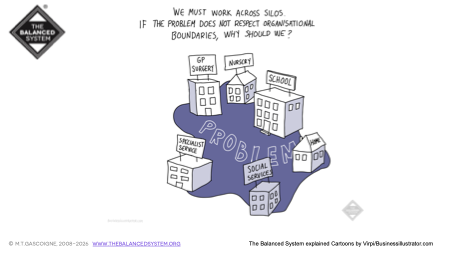
So, how does the Balanced System address these challenges?
In a Balanced System, if the Fifteen Outcomes are to be evidenced then the delivery model has to address these Five Core Delivery Principles.
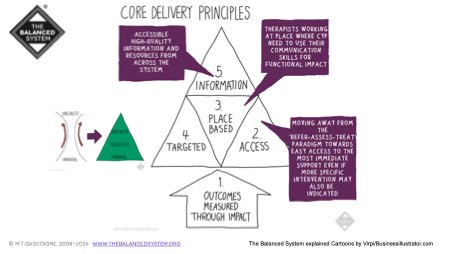
CORE DELIVERY PRINCIPLE 1: Outcomes measured through impact
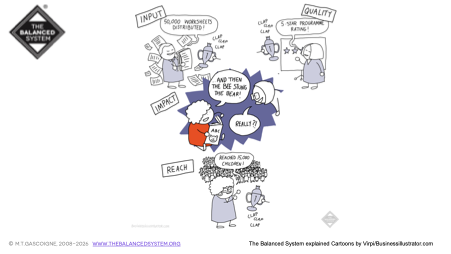
We have to drive the system by valuing and agreeing to measure IMPACT! By this we mean actual functional change for children and young people to be able to achieve their best potential in the areas that matter to them most.
Our systems tend to focus on measures of INPUT, REACH, and usually QUALITY – all of which have their place but none of which actually provide evidence that the various inputs and provisions have actually made the anticipated or hoped for difference for the child or young person.
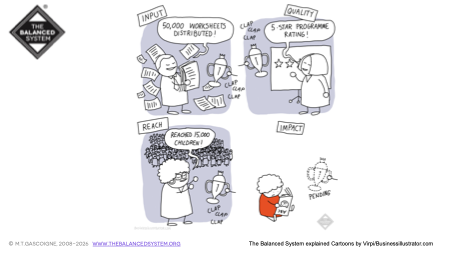
If we can shift our thinking to start with how we will measure impact then the input, reach and quality metrics become a given.
Then follow the three central ‘game changer’ core delivery principles that work together to really change system delivery: Easy Access, Place Based support, and a continuum of offer that includes a robust Targeted offer between the universal and the specialist or individualised and avoids the ‘vortex’ effect.
CORE DELIVERY PRINCIPLE 2: Easy access
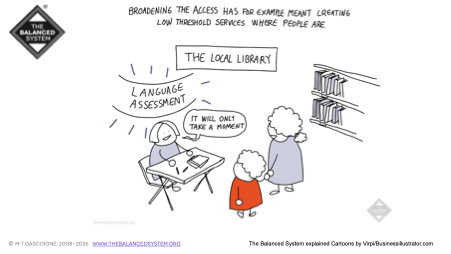
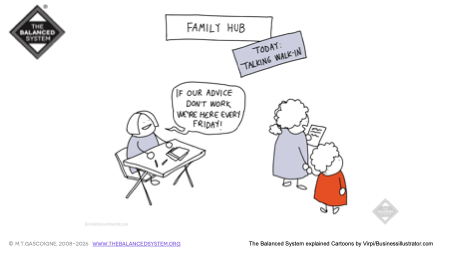
The second core delivery principle addresses the queue! Using population and demographic data along with the evidence base around prevalence, we anticipate where need is likely to be highest, we anticipate where communities may benefit from might be termed targeted in one area but delivered universally, we bring our experts out into the places families access, for open door opportunities to get advice and support and even initial assessment.
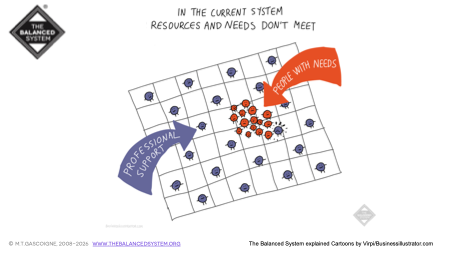
Rather than having our professional support evenly spread, we move it to where we anticipate there is more need.
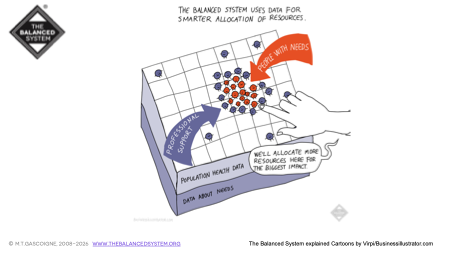
Rather than the gate keeper of the long queue, we open access to come in and out of an advice and support offer as and when needed
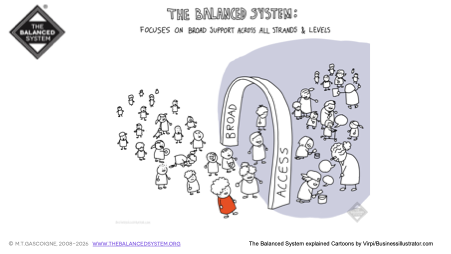
This might involve open access sessions in community bases and crucially in schools and settings.
CORE DELIVERY PRINCIPLE 3: Place based
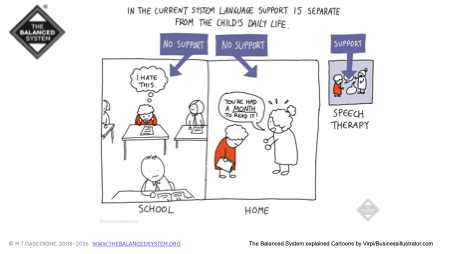
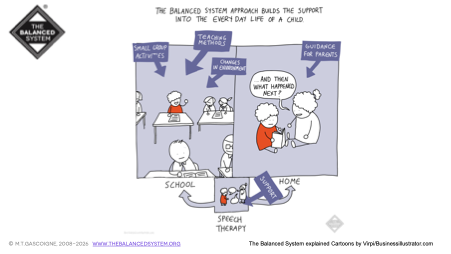
As we’ve said, easy access and being placed based have some overlap but there is more to being truly place based that the opportunity for initial contact.
I’m going to illustrate this through the concept of the Link Therapist – in this example it is a speech and language therapist but the same concept applies for any of the therapies.
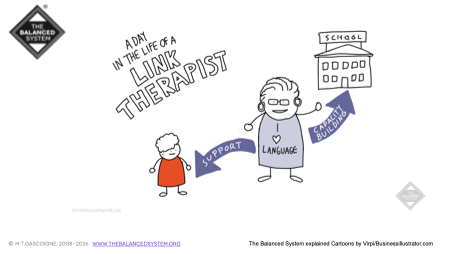
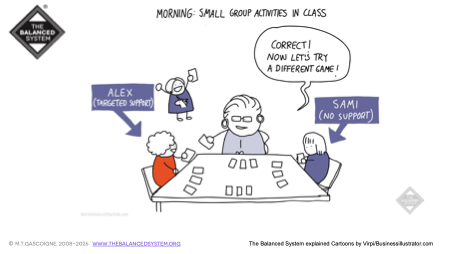
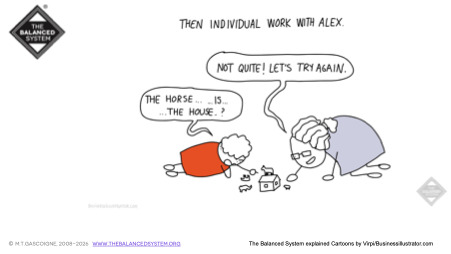
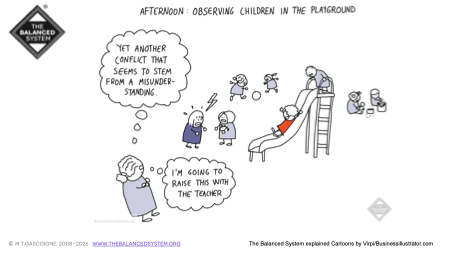
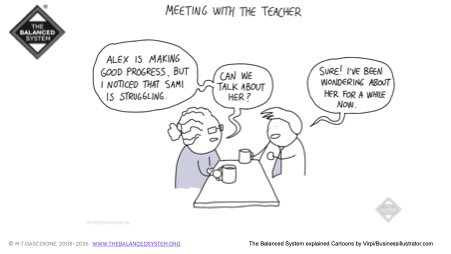
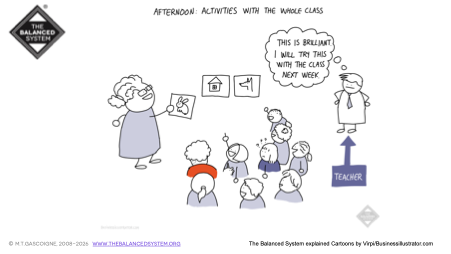
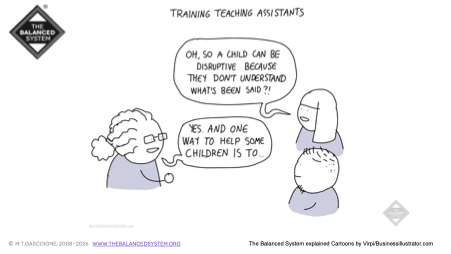
Many of you may be looking at this and thinking – but how?
Let’s look at CORE DELIVERY PRINCIPLE 4 first and then we will come back to that!
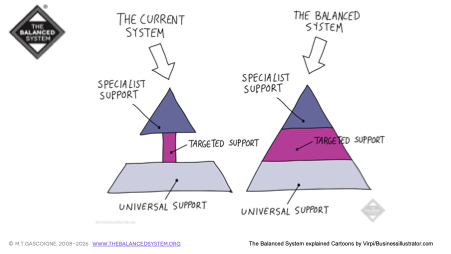
The Continuum of offer – ensuring an effective targeted offer exists at place.
Some really key points about a Balanced System targeted offer and the definition set out in the Position Paper I mentioned from 2006 – remembering that before that, this language of levels – I don’t call them tiers – was not used in the context of therapies or support for SEND.
A targeted offer is NOT training – it might involve training but that is only in order to provide skills and competences in the workforce.
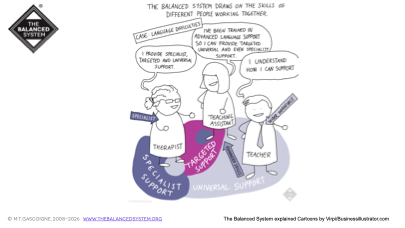
A targeted offer can be (and should be as appropriate) delivered by a member of the therapy team, a registered therapist or an assistant practitioner – it isn’t all about school or setting staff being responsible for the delivery – it’s a system partnership.
Because a registered therapist (‘the specialist’) carries out an element of support, whether with a group or an individual – it doesn’t make the thing they are doing automatically ‘specialist’.
Equally, we offer support and train families, setting and school staff and other health colleagues to deliver specific individualised or specialist elements of support under direction. This helps them to help the child in daily activities.
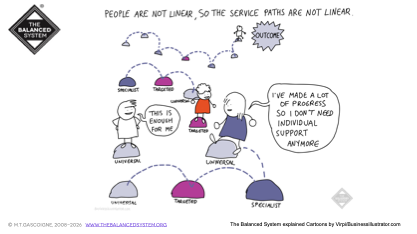
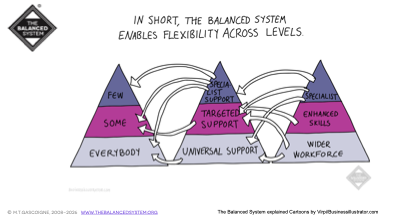
Finally and most crucially, children and young people may access a combination from a ‘menu’ of universal, targeted and individualised or specialist support at any one time to give them their own unique journey towards their outcomes. Rigid pre-determined siloed pathways have no place in a Balanced System.
Hopefully the following illustrations will help clarify these crucial points.
Before we get back to the ‘how?’ the final CORE DELIVERY PRINCIPLE 5 is Information
Families and practitioners struggle to navigate the huge amounts of information available nationally and locally and quality assurance can be a real issue. For that reason once the system delivery is in place to meet the system outcomes – a high-quality accessible information resource is essential. Current system struggle between organisation, across statutory vs more general information etc.
Ok – so HOW?
Any area can move to deliver through these Core Delivery Principles so why in practice does it require so much support. It is a wicked problem. The areas that have successfully embedded this approach have had:
1. Strategic support across the local system
2. Commissioners of all persuasions coming together to recognise they all hold funding for the same children so there is a logic in getting away from silo commissioning towards aligned or joint commissioning but in the meantime at least agreeing to a common outcomes framework
3. Operational leaders coming together at locality level to plan together, map their current offer, avoid duplication of effort and therefore use total resource to its best effect
4. Practitioners who are willing and supported to put the child, young person and family at the centre, even if it means working slightly differently
5. Families are central to the planning, so that they have confidence in the proposed ways of working as there is always a space between systems that causes anxiety
The right implementation plan for each area will be different, but the Outcomes Framework and Core Delivery Principles are consistent and need to be the shared reference point if it is to embed.
We know resources are scarce, this way of working is about making the most of what is available in a collaborative approach. We are looking forward to exploring the necessary therapy workforce resource to meet need in our MOTIF study funded by the NIHR for the Department of Health and Social Care – but there is no need to wait!
Therapists working in the places children and young people spend their time, instead of traditional health settings works! There is evidence from areas across the UK: Worcestershire, Hackney, Kent, Essex, Devon to name but a few. Greater Manchester are taking a strategic approach to transformation using the Balanced System across all ten Local Auhtorities. Stockport started ahead of the other areas and are already seeing significant change.
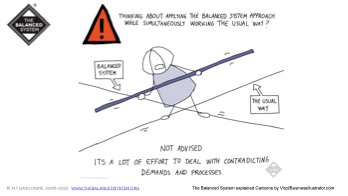
I’ll showcase each of these in future blogs but for now a final word – to implement a whole system change requires a ‘big bang’ approach – running two contradictory systems together is often difficult, confusing and rarely the best way to achieve change.
Tagged under: